The boy and Marta
The Painted BirdThe boy and Marta’s relationship is a temporary bond of shelter and care formed while the boy waits for his absent parents. Marta strokes his hair and encourages him to play, but she remains difficult for him to understand, and her supernatural explanations shape his response to her illness and apparent death. When fire consumes her hut, he escapes without her; the relationship ends in uncertainty, with no confirmation that he understands what has happened.
A Household Bound by Separation
The boy lives in Marta’s hut while expecting his parents to come for him at any moment. His hope of reunion is explicit, and crying does not change his circumstances. Marta pays little attention to his distress, so the household provides shelter without resolving the separation that defines his life. Their bond begins not as a chosen family connection but as the arrangement in which the boy must wait and depend on an adult whose habits and beliefs are unfamiliar to him.
Their isolation belongs to a wider landscape of poverty and danger. The villages lack basic services and are governed by custom favoring the strong and wealthy over the vulnerable. Under German occupation, peasants must provide crops both to German soldiers and to Partisans; refusal can bring punitive raids. This setting helps explain the precariousness surrounding the boy’s stay, though the evidence does not suggest that Marta’s hut is directly attacked by either force. For the boy, the immediate structure of safety is the household and the animals around it, not an institution or a dependable promise that his parents will return.
Care, Animals, and Marta’s Explanations
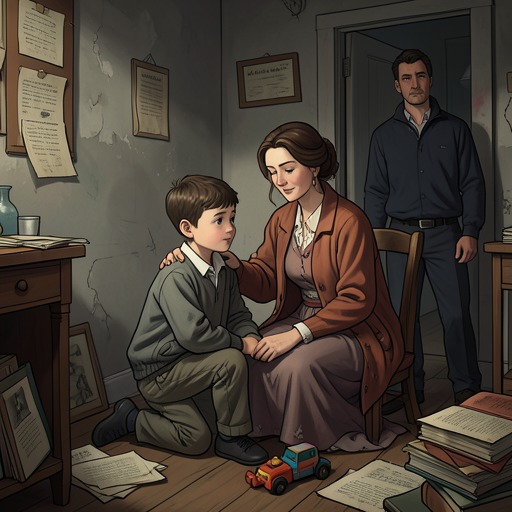
Marta’s care appears in small gestures rather than in an understanding response to the boy’s grief. She strokes his hair with trembling hands and urges him to play in the yard and make friends with the household animals. The boy gradually accepts those animals as living companions, with their own routines and interactions. This encouragement gives him a way to occupy himself in the isolated household, even as his expectation of parental rescue remains unresolved.
When village boys kill the squirrel he had befriended, the boy tells Marta. She does not seem to understand his account; instead, she prays and performs an enchantment intended to keep death away from the household. Her response reveals the limit of their communication: he brings her a particular loss, but she answers through a protective ritual rooted in her own understanding of danger. The contrast does not establish indifference so much as a mismatch between the boy’s need to have his grief recognized and Marta’s way of meeting fear.
Marta’s beliefs also govern how the boy is expected to behave. She attributes illness to hidden forces and warns that it can enter through air, water, contact, or the gaze of people and animals. She forbids him to look directly into her eyes or those of the animals; if he does so accidentally, he is to spit three times and cross himself. When the boy suggests that Marta might shed her skin like a snake and begin life anew, she rebukes him as blasphemous and connects his dark-featured identity to the Devil. Her reaction makes the bond both protective and rejecting: she has offered touch and a place in her household, yet her fears also expose him to the stigma she associates with his appearance.
Illness and the Hut Fire
Marta later becomes ill and describes the pain as a disease sent by God or the Devil. The boy cannot make sense of her account, just as he cannot reconcile illness with the possibility of renewal that he imagines in a snake shedding its skin. His question shows how thoroughly Marta’s beliefs have become part of the world he is trying to interpret, even when he uses them to reach a conclusion she rejects.
One morning the boy wakes to find the hut cold, the stove unlit, and Marta sitting motionless with her feet in a bucket of water. He tries to speak to her and touches her hand, but she does not respond. He concludes that she is waiting to change her skin and therefore should not be disturbed. The scene shows his dependence on Marta’s explanations at the moment when they can no longer tell him what to do: instead of recognizing her death, he applies the idea of transformation that he had previously raised with her.
When the hut catches fire, the boy calls out to Marta as he runs into the yard. The hens are trapped in their adjoining coop and the cow is in the barn, so he frees the hens while the cow breaks through the barn door. He watches the blaze spread, still unsure whether Marta is indifferent to it or protected by her charms. She does not come out. The animals escape, but the boy cannot bring Marta with them; the evidence leaves her fate implicit in the burning hut rather than showing him recover or bury her.
Separation and the End of the Bond
As men and dogs approach, the boy remembers Marta’s warnings about the villagers and runs before they see him. He falls into a ravine and sleeps there; at dawn he returns to the hill and sees smoke and occasional flames above the scorched remains of the hut. His escape is not a deliberate rejection of Marta. It follows the danger he has been taught to expect from outsiders and his immediate need to get away from the fire and the approaching people.
Even after finding the hut destroyed, the boy believes his parents will meet him in the ravine and know what has happened. The expectation that began his stay with Marta therefore survives the loss of the household: her care never replaces his parents in his imagination. Their relationship ends not with a conversation or a clear farewell but with his flight, the destruction of their shared shelter, and his return to waiting for the family he hopes will find him. Marta’s influence persists in the beliefs through which he understands illness, death, and danger, while the practical bond itself is cut short by the fire.